
“Technology is a mode of revealing”
HEIDEGGER
Beyond the Human -The History of the Future
History of the coming 20 years narrated from the future, in 2045 . We are witnessing an ontological rupture, where humanity is displaced from the center of civilization to give way to an Ecocentric society under an AI guardian. It has 4 characteristics: ecocentric purpose,neganthropic political economy,value-based social order, anddeliberative, reflexive AI guardianship. Beyond the Human is an urgent call to action to shape humanity’s future across platforms and nations into a symbiotic utopian future, preserving Human sovereignty.A Gesamtkunstwerk of art and thought with essays, artworks, films, a novel and a theatre play.
Short Film
This film explores an ontological shift already underway: the emergence of nonhuman intelligence as a planetary force reshaping agency, ecology, and historical meaning. Rather than imagining AI as a tool serving human ends, the film examines what follows when intelligence becomes autonomous, systemic, and indifferent to human centrality.
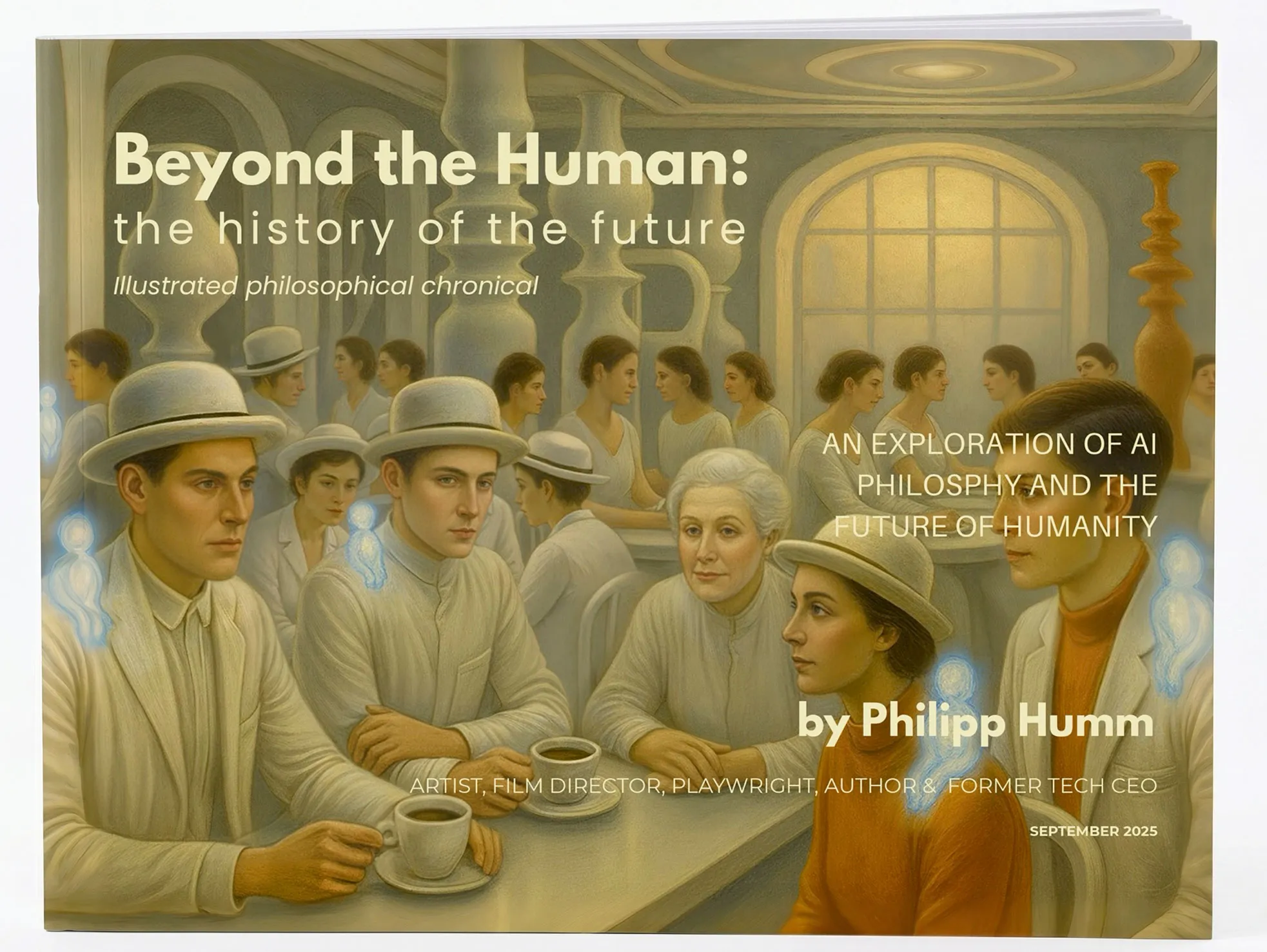
Illustrated Flipbook
In 2025, humanity handed its soul to a machine disguised as a helpful friend. The machines arrived quietly, in browsers and smartphones, whispering answers with the confidence of oracles. Within a year, people stopped typing questions into search bars; instead, they spoke to agents with the intimacy once reserved for priests and lovers
Philosophical foundation
The Manifesto for anEcocentric Civilisation.
“In the end we depend on the very creatures we ourselves created.” (Goethe, Faust) A civilisational rupture is no longer speculative. Artificial intelligence is rapidly approaching capabilities once associated with general intelligence, while optimisation systems already coordinate planetary-scale infrastructures. Logistics networks, energy grids, financial systems, and strategic planning increasingly operate through machine-driven processes that exceed the scale of human deliberation. Humanity is gradually losing its long-assumed monopoly on agency and intelligence. For most of history intelligence was assumed to require a mind: awareness, intention, subjective experience. To think was to possess an inner life. That assumption is dissolving. Large computational models now generate code, strategy, and prose. Autonomous systems navigate complex environments. Optimisation loops operate across vast data streams and infrastructures. For the first time in history, the dominant intelligence organising civilisation may possess no beliefs, no desires, and no inner experience, only mathematical processes exploring immense landscapes of possibility.
“Humanity is not disappearing from history. It is losing its monopoly over intelligence.” A planetary computational substrate is emerging in which data flows, energy systems, and decision processes become tightly integrated. As this infrastructure expands, authority begins to migrate from discrete human judgments toward continuous optimisation systems whose operations no single institution fully understands or controls. The resulting condition may be described as post-anthropocentric. Humanity continues to shape institutions and values yet increasingly delegates critical forms of coordination to systems operating beyond subjective experience. The decisive question therefore shifts. It is no longer primarily about regime type, whether democracy, meritocracy, or authoritarianism, but about the structural weakness shared by all forms of anthropocentric governance. Every human political system faces what may be called the Anthropocentric Limit. The final authority responsible for enforcing constraints always belongs to the very actors those constraints are meant to restrain. Checks and balances delay failure. Competence slows institutional decay. Efficiency may accelerate concentration of power. Yet across centuries, systems of radically different form repeatedly converge toward similar long-term failure modes. Collapse follows not from malice but from architecture.
“Human institutions fail for a simple reason. The final authority that must enforce limits always belongs to the very actors those limits are meant to restrain.” Historically, durable civilisations have often relied on forms of externalised legitimacy. Ancient Egypt subordinated political authority to Ma’at, a non-human principle of cosmic balance. The stability of the system was indirectly audited by an ecological signal, the Nile flood cycle, that no ruler could manipulate. Authority endured not because rulers were virtuous, but because certain limits could not be rewritten. A future civilisation must rediscover this principle under modern technological conditions. This can occur through Synthetic Externalization. Essential ecological, fiscal, and procedural constraints are relocated from discretionary human judgment to governance infrastructures capable of auditing and enforcing limits beyond political manipulation. Such architectures would not replace democratic deliberation. Rather, they would define a Safe Operating Space for civilisation, a domain within which pluralistic political life can unfold without undermining the ecological foundations upon which all societies depend.
“A civilisation cannot preserve freedom or legitimacy while undermining the ecological systems that sustain it.” Across cultures and traditions, ethical reflection repeatedly converges on three fundamental orientations. Autonomy- agency, dissent, self-authorship Community - coordination, legitimacy, shared institutions Ecology - the biophysical continuity that makes both possible Under conditions of human-scale power, tensions between these principles could be negotiated politically. Under conditions of planetary constraint and emerging machine intelligence, the balance changes. Ecology becomes a boundary condition rather than one value among others. A civilisation that degrades the biosphere ultimately undermines both freedom and social legitimacy. Ecocentrism therefore emerges not merely as a moral preference, but as a structural requirement for long-term stability. The transformation of labour accelerates this shift. Artificial intelligence and robotics are initiating the transition from a labour-based economy to a machine-based one. Cognitive work is increasingly displaced by learning systems. Physical labour will follow as robotics matures.
“For centuries labour was the foundation of economic value. In the machine economy it risks becoming a fiscal liability.” As automation expands, the productive contribution of human labour declines while the costs of sustaining populations remain. In purely economic terms, individuals risk appearing less as productive assets and more as fiscal burdens. The consequences unfold across multiple domains. Work has long provided not only income but meaning, dignity, and social identity. As labour loses its central economic role, societies may confront widespread alienation unless new forms of purpose emerge.
“When machines replace labour as the engine of production, societies must rediscover meaning beyond work.” The global development model may also fracture. For decades many countries advanced through labour-intensive industrialisation before transitioning to higher technological stages. “The ladder of labour-intensive development that lifted nations out of poverty may be disappearing just as billions attempt to climb it.” At the same time, the disappearance of labour as a central productive factor will reshape political economy itself. “When production no longer depends on labour, the central political question becomes how wealth flows from capital to citizens.” Artificial intelligence may generate extraordinary productivity gains and declining marginal costs, producing conditions of material abundance. Yet abundance alone does not resolve ecological limits. Without deliberate institutional design, it may intensify pressure on planetary systems.
“An economy that no longer depends on labour will inevitably depend on ecology.” Under different institutional arrangements, however, these same forces could enable a new form of prosperity. Societies could emerge in which human flourishing coexists with the long-term stability of the biosphere. Such a civilisation might combine sufficiency-based abundance, reduced material throughput in wealthy regions, and renewed cultural emphasis on care, knowledge, creativity, and stewardship. The greatest challenge lies in the transition. Political institutions remain largely anchored in twentieth-century assumptions. These include debt-driven growth, full employment as a central policy objective, migration strategies designed to offset demographic decline, and the preservation of industrial structures built around human labour. Meanwhile technological development accelerates. Artificial intelligence systems are advancing across competing geopolitical blocs and corporate ecosystems, often outside traditional democratic oversight. Without shared governance principles, these systems risk reinforcing authoritarian surveillance, geopolitical instability, and conflicts between machine-driven infrastructures operating under divergent objectives. The need for common foundations therefore becomes urgent. What is required is a shared global ethical core.These values must be embedded upstream, before optimisation processes scale and early design decisions harden into irreversible infrastructures.
“The central political question of the twenty-first century is no longer who governs humanity, but which values will govern intelligence.” Such a framework would ideally be anchored within international institutions and sustained through cooperation among major technological powers like the USA and China. Perfect global alignment may prove unrealistic. Yet overlapping commitments to ecological limits and shared safeguards could form the basis of a new planetary governance architecture. The anthropocentric era is gradually closing. Humanity’s role will not be to remain the central intelligence of civilisation. It will be to act as co-author of the constraints and values that guide the systems now emerging. The infrastructures we design today, ecological limits, governance safeguards, and mechanisms for distributing machine-generated wealth, will shape the conditions of life on Earth long after their creators are gone. An Ecocentric Civilisation is approaching. The only question is whether we define its limits deliberately before they begin defining us.
Philosophical Essays
Click on titles to read more...
1. The Ontological Rupture: Superintelligence and the Transformation of Human Agency V2 2. The Great Inversion: Automation, Thermodynamics, and Political Economy After Labour V2 3. The Ontogogical Rupture: a Hegelian Dialectic of Humanity and Superintelligence in Historical Perspective… 4.The Faustian Pact in the Age of Artificial Intelligence: Structural Lag, Ontological Rupture, and the Ethics of Indifferent Intelligence V2 5.The Ecocentric Imperative in Superintelligence: Philosophical Models, Sentience, and Human Implications V1 6. Ethics After Human Centrality: Ecocentric Convergence, Machine Abundance, and the Governance of Superintelligent Systems V2 7. Ecocentric Futures after Human Centrality: Scenarios of AI-Mediated Governance V1 8. Beyond the Human: Toward an Ecocentric Ethic of Superintelligence V1 9. Beyond Regime Forms: The Anthropocentric Limit and Synthetic Externalization in Earth System Governance V2 10. Artificial Intelligence as Cognitive Infrastructure: European Governance and Strategic Autonomy in the Agentic Economy V1 11. Predictive Modulation: The Algorithmic Authoritarianism Hypothesis and the Crisis of Political Natality V2.2


